




Field Day provides great practice setting up antennas "on the fly" somewhere other than on home turf. However, it is a planned activity, and the event venue is often the same one, two, or few places. As a result, setting up becomes almost a reflex action in some cases. Good practice, and well worth the effort, but we often don't need to consider things like we did the first time or two we setup somewhere.
Things we have to consider when setting up at an unknown location include site selection and safety, the most efficient means of getting up and operating, propagation and proper antenna orientation, optimizing the installation, and the need to avoid some pitfalls related to setting up "on the fly".
When arriving at a new location we need to consider takeoff angles for HF and line-of-site for VHF/UHF,
relative to any obstructions. A great antenna install right next to a building will probably not give the performance desired. Likewise, we need to consider hazards, like power lines, water, or structures or devices very near the installation. Situational awareness is the phrase for this step.
Rapid deployment, keeping safety in mind, is the next step. You've looked at the environment and determined the best (or least bad) place to install the antennas. Now you need to get them installed. Lightweight masts, fiberglass poles, or improvised supports like flagpoles, trees, and even vehicles can be used.
Wire antennas can be anything from an Inverted V to an End-Fed Half Wave. We generally want a NVIS (Near Incidence Vertical Skywave) setup, so at least we don't have to put great effort into having an extremely high HF antenna. Dipoles are more difficult to install on the fly than End-Feds, and the environment may dictate what you use, regardless of what you might prefer.
Vertical antennas, especially for VHF/UHF ought to be seriously considered. But don't rule out verticals for HF - assuming the site provides a practical means of placing one. Again, being NVIS, and verticals being less sensitive to close proximity to the ground, verticals can be a great option.
Getting back to UHF/VHF antennas, Roll-Up J-poles, Slim Jims, and even mag-mounts on a car can all work well for these bands. Tossing a rope over a tree and pulling up a Roll-Up antenna is pretty simple. Let's also not forget the recently demonstrated "Flower Pot" antenna, which can literally be stood up in a flower pot or bucket or even hung from a tree.
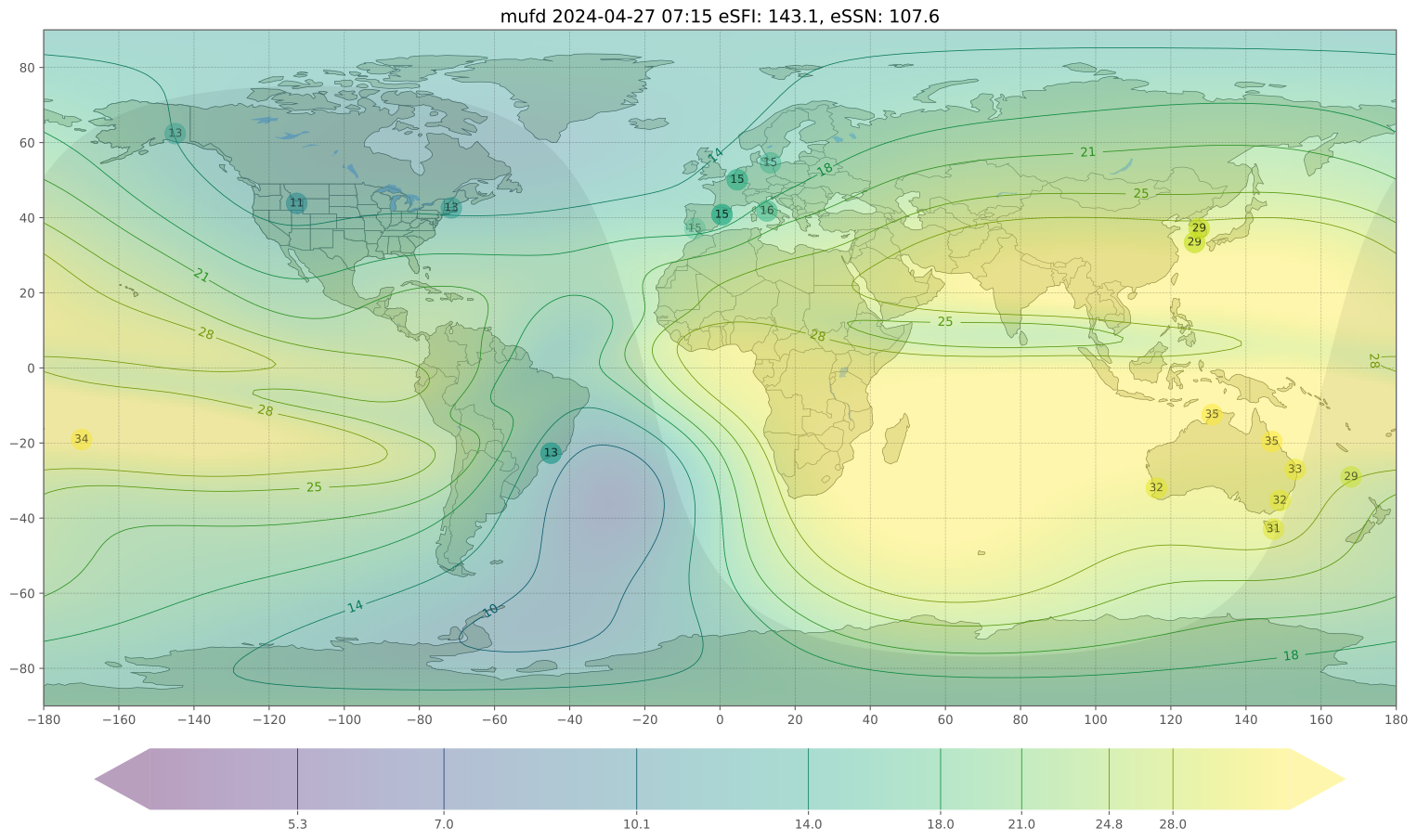
Propagation should be thought through before even starting to setup. Do we need NVIS or DX? Normally NVIS is desired. So, low flying dipoles or End-Feds may get the job done for you in most cases. However, verticals can be useful for both NVIS and DX, merely by increasing its height above the ground. Make sure the VHF/UHF antenna is placed where there is an adequate view of the horizon in the direction of repeaters or other simplex stations you'll be trying to contact. Likewise, an obstacle-free orientation for the HF antenna will improve performance, although HF is a bit more forgiving in that area, especially when operating NVIS.
Having an optimal installation as is possible should be the goal. Try to minimize feed-line length, especially for the higher frequencies. An antenna analyzer or VNA ought to be part of any deployment (Nano VNAs are pretty low cost). If an analyzer or VNA is not in the cards, at least have an SWR meter to check the radio to antenna match. Remember, check with low power so as not to blow the finals in your radio at the worst possible moment.
Grounding is often ignored, but can often help minimize noise and RFI. I know there are a few of you that ask "What is this 'Ground' you speak of?" Extra wire for counter-poise and as make-shift radials might be good to have on hand, although I strongly suggest using an antenna configuration that minimizes the need for either, but especially radials.
Make sure you have a way to waterproof connections; perhaps some guy wires to help support or stabilize an antenna, such as a Flower-Pot or even a J-pole that might otherwise sway or swing in wind. Keep in mind wind and rain will affect SWR, so minimizing impact of these is important.
Test and operate at the lowest possible power settings. In emergencies we will often be operating from battery or some other power source that is very finite. I'm very excited at the prospect of operating Field Day QRP on battery. While it may not be disaster level adverse conditions (we hope), the fact the bands will be awash with "interference" will provide a challenging, while fun, environment to test QRP with battery communications.
We must also consider the fact that operating in a disaster is a far cry from our everyday, and even Field Day, operations. Repeaters we count on may be offline. We may find conditions are too harsh for a make-shift mast, especially a very tall one. Poorly maintained equipment can lead to high SWR and equipment failures. Generators and emergency lighting (especially LED) may introduce interference. Remember, no matter how well we plan, SOMETHING will break it.